

Recap: In the foreword, I borrowed the metaphor of a moral landscape, and argued that we climb it in an epistemic fog. But before we can move up and down the landscape, we need to know which way is up: what good is, and what is good.
Thomas Paine built his theory of government by starting with a few people alone in the wilderness. This series does the same, building a theory of morality from the simplest possible point: a rock alone in the universe.
I claim that without someone to experience the world, nothing is better or worse. This belief decides why a dog’s pain matters and a thermostat’s doesn’t, and whether an AI could ever be wronged.
In the Beginning
In the beginning the Universe was created. This has made a lot of people very angry and been widely regarded as a bad move.
Douglas Adams, The Restaurant at the End of the Universe
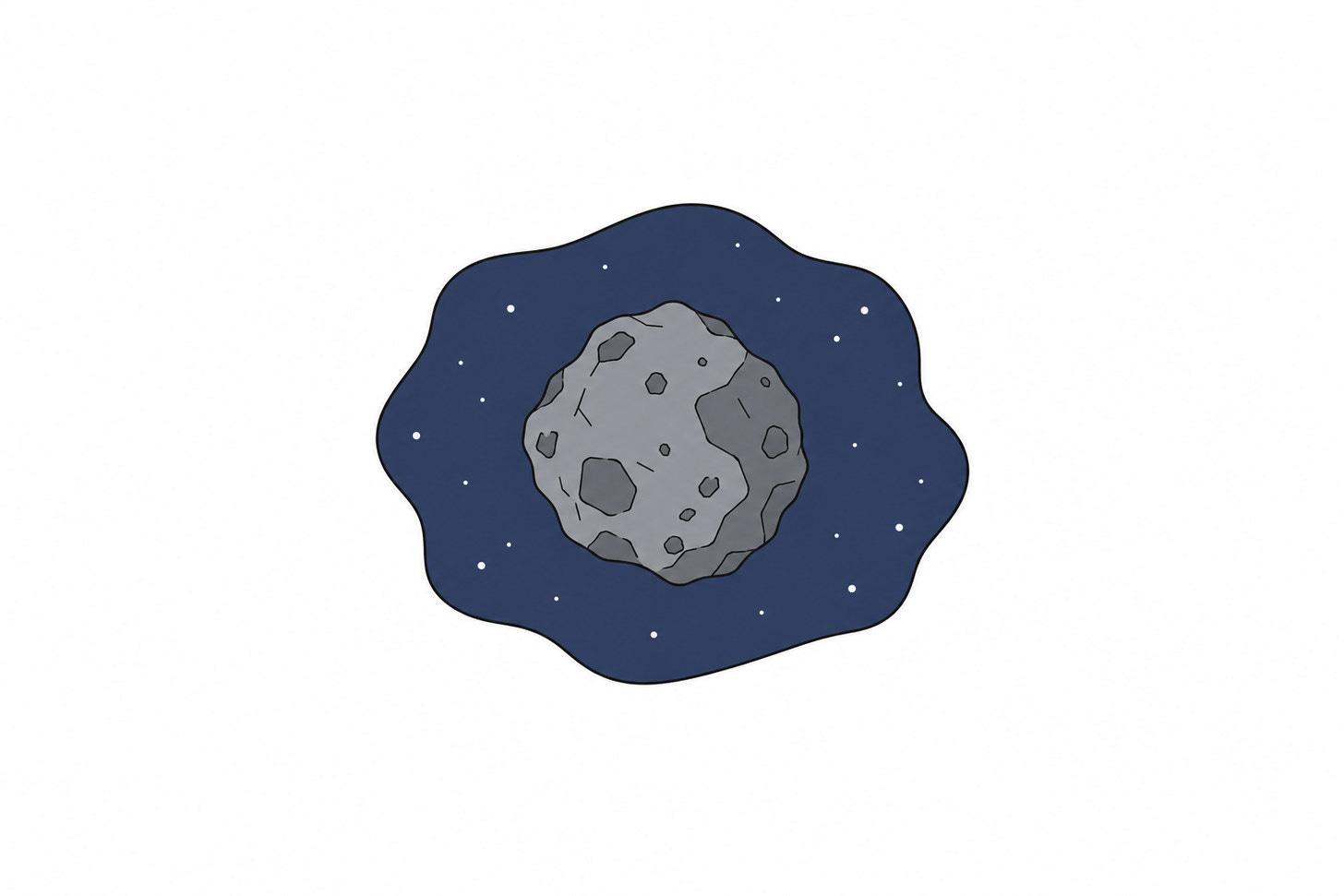
Imagine that all of space consists entirely of a floating rock in a void of nothingness.
It seems impossible to attribute any sort of value to it. If it were to crack and break apart, it would not experience pain. Nor is it better as one rock than as two smaller broken ones. Any position in space, any rotation of it, any state this rock can ever occupy is equivalently meaningless. There is nobody to care how this rock could be changed for better or worse.
Note 1: Many readers will say no universe is ever truly empty. God may be there, or, if the panpsychists are right, some flicker of experience runs through matter itself. I ignore these objections here, not to deny them, but to isolate the one variable (subjective experience) that I care about.
Notice that if these objections are true, they leave the claim intact rather than undercut it. A universe watched by God is never empty of experience. Whatever value it has would still be value to someone (in this case, God).
Now imagine instead this rock to be not just any rock, but in fact marble. Beautiful, white, rich, textured marble. Marble, as it were, shaped into Michelangelo’s David.
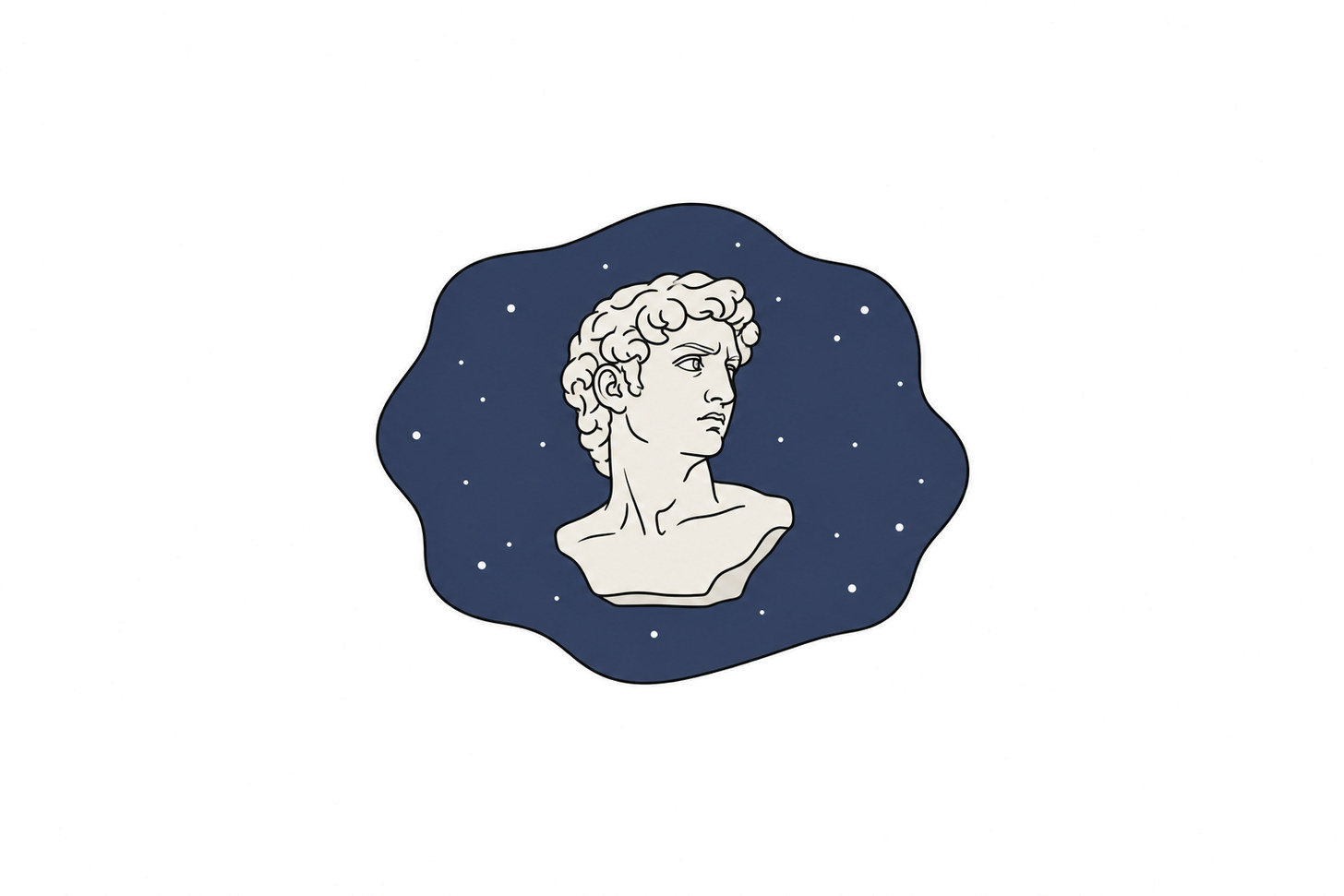
This is no longer a chaotic, formless asteroid alone in the void, but an object of immense order, structure, and beauty. If we were given the choice between a universe of an asteroid and one of a floating statue, could we say one was better than the other?
We humans value order. We value beauty. We value the things that David represents. But in this universe, we do not exist. This universe has only David. And David, like most marble, feels nothing at all. Furthermore, despite it being beautiful (to me), there is no being to witness this beauty. There is no experience by anyone or anything that is made better or worse by having David’s universe versus that of the simple asteroid.
Note 2: The philosopher G.E. Moore ran this exact test in his 1903 book Principia Ethica, with whole worlds instead of a rock and a statue, and he came out the other way. He imagined one world of exceeding beauty and another that was a “heap of filth,” neither ever seen by any human being, and concluded that the beautiful one was better, that beauty has intrinsic value even with no viewer.
But I think he quietly imagined himself standing in it, judging. As I see it, some beings could see the floating asteroid as beautiful simplicity and the carved David as a horrible, forced destruction of the purity of rock.
“Beauty is in the eye of the beholder,” as they say. And without a beholder, there is no beauty.
If we accept that there is no moral difference between the just-David universe and the just-asteroid universe, it follows that there would be no moral implication of David undergoing a gravitational collapse into that simple rock. Physical change that does not touch any subjective experience simply does not matter, morally speaking.
We can take this further. Let us now take our asteroid and grow it to the size of a planet. And put water on this planet, and add lava, and dirt, and call this planet “Earth.”
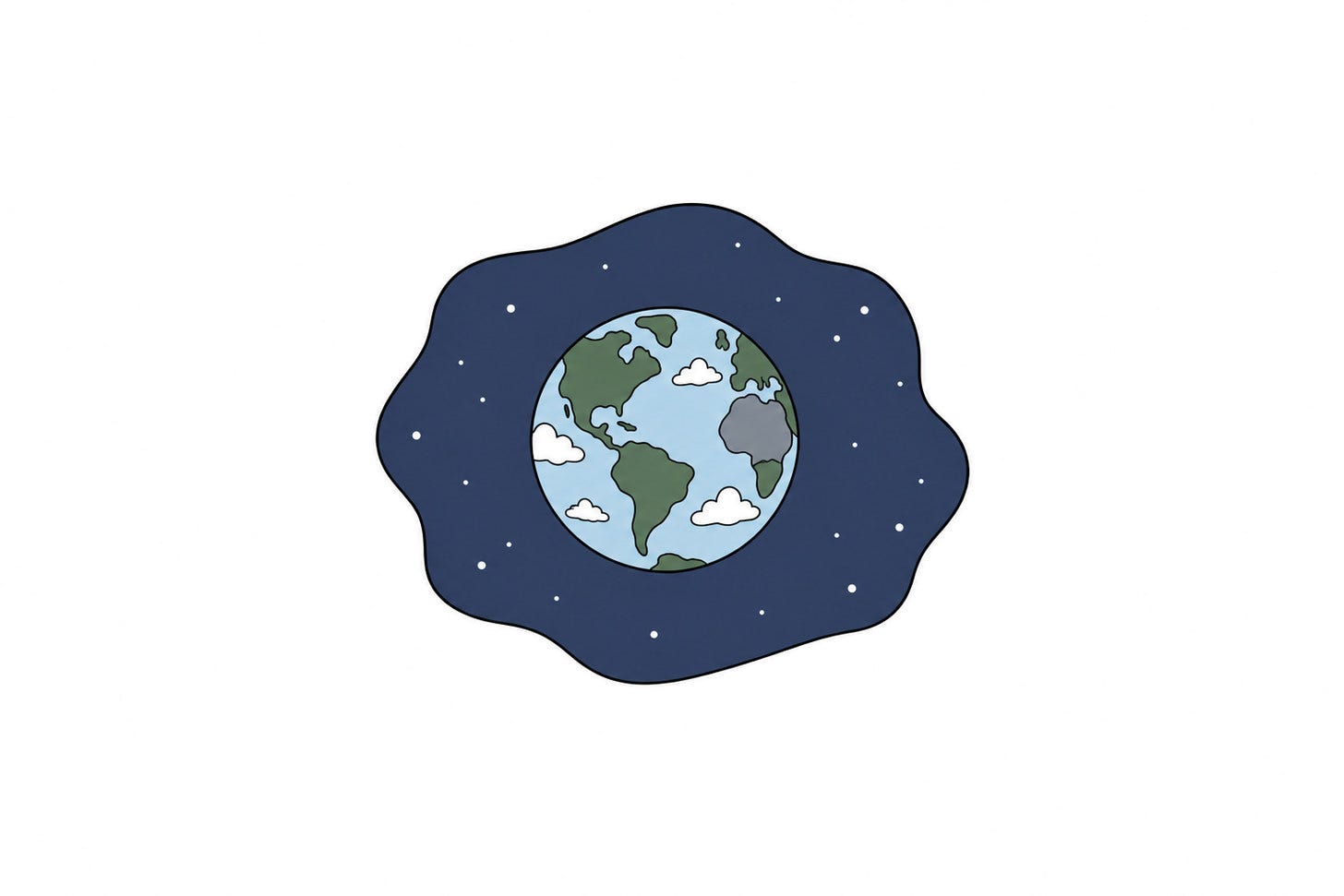
Assuming water can’t consciously experience anything, if our asteroid were instead a ball of floating water in the void, the scenario would hardly change. Other earthen materials complicate the structure of the planet but not of subjective experience.
But then imagine bacteria develop, plants grow. Life spawns. Does this change the computation?
This is a tougher question than it seems. Compare three worlds:
a world akin to the pure, raw, floating asteroid,
a world that looks much like Earth, but barren: water, dirt, and rock, and
a world like Earth which is populated with trees and plants and algae.
It feels hard to deem them equal. One is a world full of life, and the others are devoid of it. The statue of David can be manipulated physically, spun, moved, or broken. But plants can grow, they can wither, they can reproduce, and they can die.
Since attributing conscious experience to plants is difficult, I will delay tackling it for now as it doesn’t matter to the point I’m making. First, let’s consider the world of dandelions, moss, and bacteria under the assumption that they have no consciousness at all. This is an assumption you may not agree with, but one I’ll make to illustrate a point rather than to prove a point. If we reverse this assumption later, it will not change the argument.
If this is the case, this green planet would not be so different from the universe of David. We humans enjoy the beauty of nature. We appreciate plants. We value life. But again, we do not exist.
In this world, when a plant dies, it is a loss to no one. When a tree sprouts, it is likewise unexciting. Whole processes of nature could play out: winds carrying seeds that take root, flora germinating, and many organisms growing to span major tracts of land. Yet, those beings are unconscious (by our assumption), and there is nobody to appreciate such things, and the things themselves are unaware of their own existence. There is no such thing as awareness. There is no subjectivity. There is no conscious experience.
Nobody Home on Zombie Earth
As a child, I occasionally imagined that I might be the only conscious person, and that everyone around me was an automaton merely mimicking human behavior. If you’ve ever thought this, or if you’ve ever watched the TV show Westworld, then you’ve already pictured what philosophers call a “philosophical zombie.” The lights are on but nobody is home.
Now imagine that our world of green develops animals. Horses are galloping. Beavers are dam-building. Bears are salmon-eating. Finally, humans come along and build cities. But every one of these beings is a zombie. A human zombie may behave exactly like you. It flinches, laughs, argues, and writes essays. But it has no inner experience at all. All life in the universe is the same as it is right now but with one difference: nothing is conscious.
These zombies might throw their hands wide but feel no joy or might cry profusely but experience no sorrow. Animate beings with no subjectivity, no emotion, no feeling at all.
This hypothetical world too is not so different from the world of Michelangelo’s David, the world of flora, or the floating asteroid. Zombie Earth is just another arrangement of physical material: more complex, but no more important.
If Zombie Earth were destroyed, nothing that matters would be lost, for the same reason nothing would be lost if David collapsed. There is no one for whom one world is better than the other.
That conclusion may feel wrong. Surely destroying a whole living planet is bad? In our world it usually would be, because someone would suffer. But while Zombie Earth is full of objectively existing beings, there is no there there: Zombie Earth has no inner life whatsoever. What makes destroying this planet feel wrong, I’d suggest, is the feeling that “someone” is being impacted or your values for life are being violated. But in this world, there is no “someone,” and you and your values do not exist either.
A planet of people who feel nothing is as morally inert as a single rock floating in the void.
Instrumental Value
The claim so far is that the universe has no moral value if it contains no conscious experience. But that does not mean there is no sense of value at all.
We could recognize a basic sort of objective value, which we can call instrumental value. Physical objects can have value in service of some end.
For example, it is good for the process of solar fusion to have hydrogen, and it would be bad for the process to not have it. Here, good and bad exist on a spectrum of usefulness.

We can draw this little relation for any pair of things. Hydrogen is (instrumentally) good for fusion. Rust is (instrumentally) bad for a bridge. Water is (instrumentally) good for a tree.
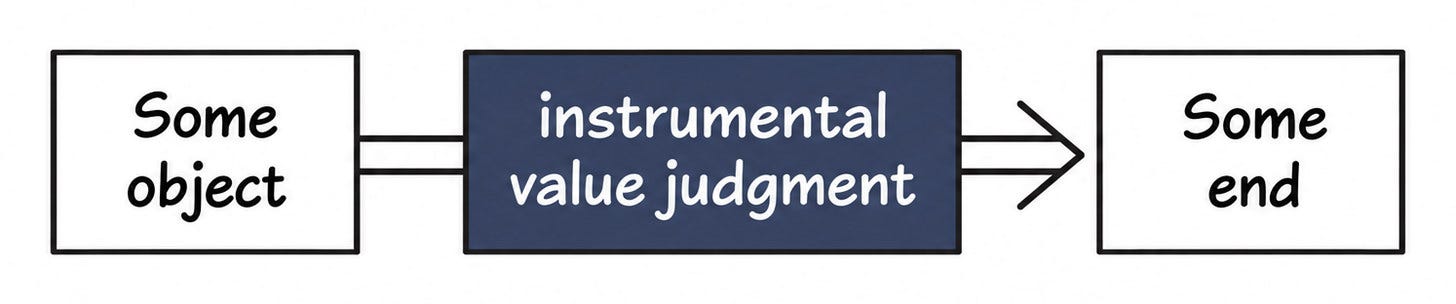
But instrumental value never matters on its own. A universe with our sun is no better or worse than one without it, unless someone lives in the warmth of its rays. Winning a game is worth no more than losing, unless someone is playing. That something is good for an end says nothing about whether the end is good in itself.
Instrumental value borrows its moral value from its ends. Every chain of instrumental “good for something” has to end in some conscious being’s experience to carry moral weight. It needs an end that is valuable for its own sake. We can call that intrinsic value. No universe we’ve explored so far has had any intrinsic value.
A physically thriving universe that is empty of experience is morally inert.
First Spark
Now imagine we leave every atom of Zombie Earth in place, but flip one switch, and suddenly let one creature feel. Someone is home for the first time.
At once, the universe changes in a way more important than mere physical changes. If a rock falls beside us, it can scare us. Sunlight warms us. Hunger gnaws at us. For the first time, things can go better or worse, because they can go better or worse for someone. With the first spark of feeling, the universe suddenly has moral direction. It starts to create positively (upward) and negatively (downward) sloped hills that define a moral landscape.
We can call this value that exists in a subject’s experience subjective value.
By “subjective” I mean that value lives in experience, not that it is relative to what anyone says. Whether value is just a matter of opinion is a real worry (and is the subject of the next essay).
Put us in front of David. Now the statue matters. It can move us, calm us, or awe us. But the subjective value lives not in the marble, which is the same marble it was in the empty universe. It lives in our experience.
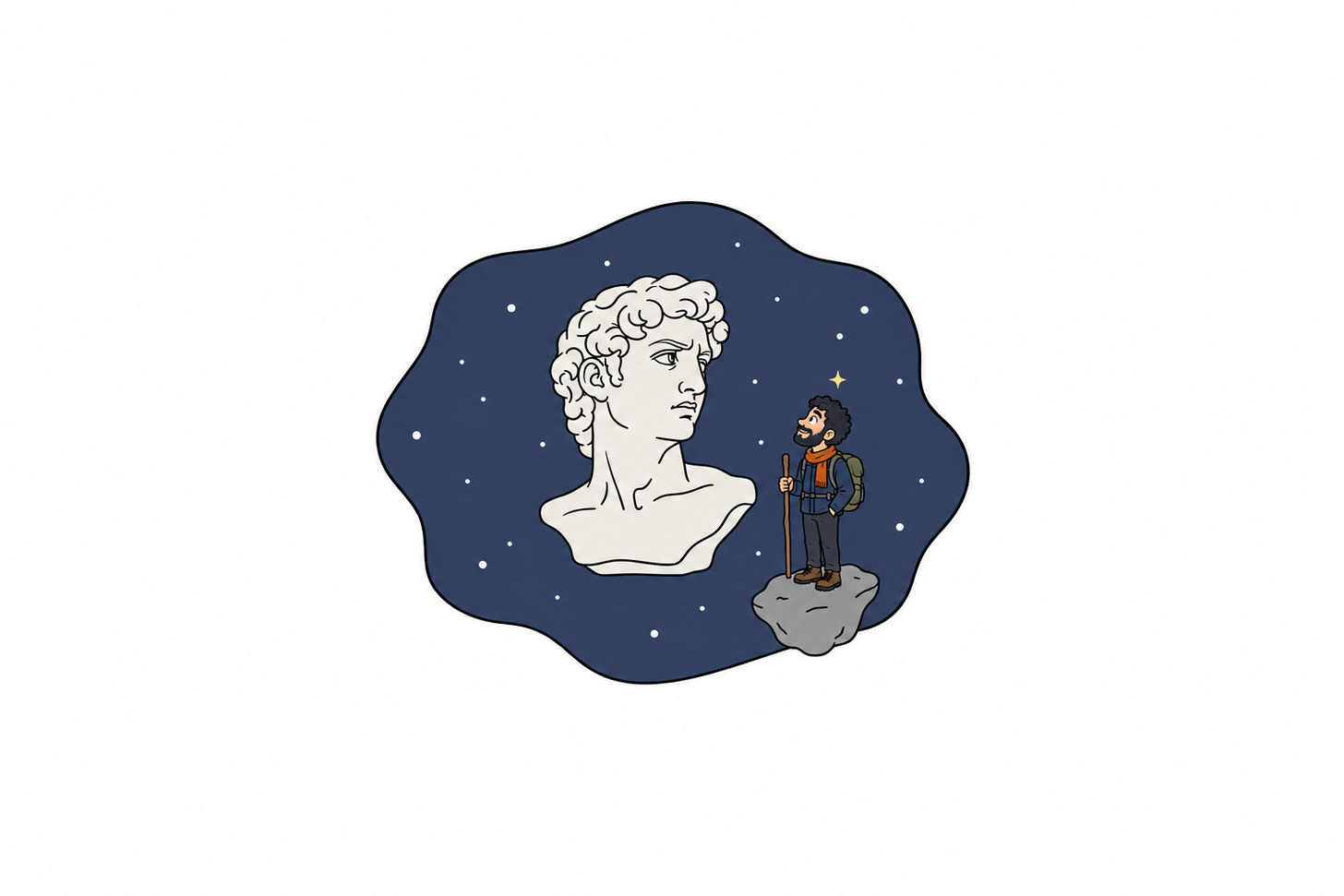
Now any chain of instrumental good has somewhere to end. Hydrogen is good for the sun, the sun is good for establishing life, life is good for us, and how our lives go is good or bad in itself. That last link is to the intrinsic value connected to our subjective experience.
This does not yet say which experiences are good. Pleasure is the obvious candidate, and I’ll argue later that it is not the whole story. Nor does it say whose experience counts, or how much. It says only where intrinsic value lives: in subjective experience.
Which Way Up?
If value lives only in experience, then a rule, a tradition, an economy, or an ecosystem matters only through what it does to beings who can feel. Why do we care about a dog’s pain and not a thermostat’s? Could an AI agent ever be wronged? On this view, those questions turn entirely on whether anyone is there to experience anything.
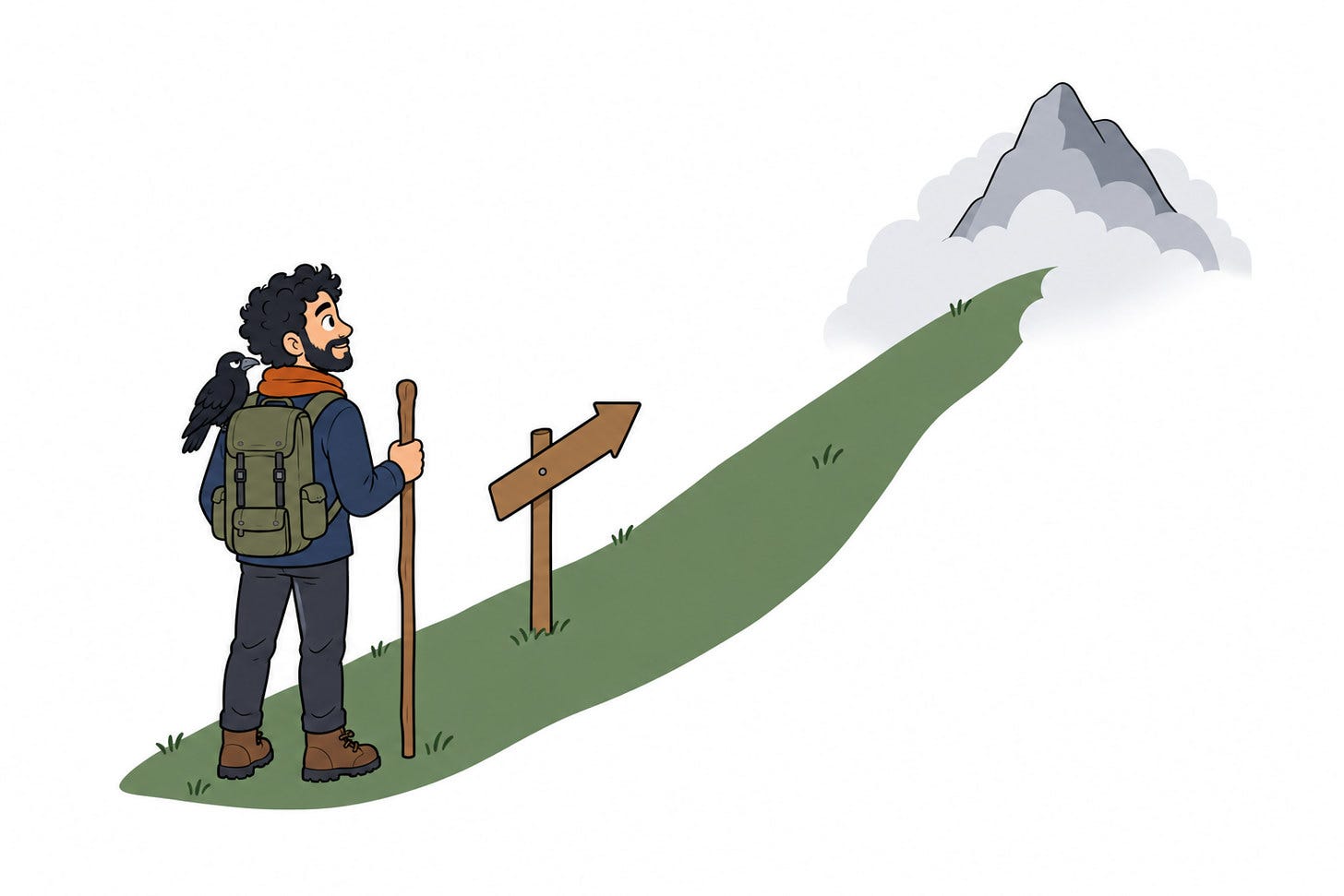
So, which way is up on the moral landscape? Three claims to carry forward:
A universe without experience contains nothing better or worse, however orderly, beautiful, or alive.
Instrumental value is real but borrowed from the subjective ends it supports.
Intrinsic value, being good or bad in itself, lives only in the experience of a conscious, subjective being. Up on the moral landscape means better for someone.
These claims raise an obvious worry. If value is always value to someone, is it just a matter of taste? If the same statue moves you and bores me, which of us is right? Is everything relative?
I do not believe so, and we will explore objective truths about subjective facts in the next essay, Good for Whom?